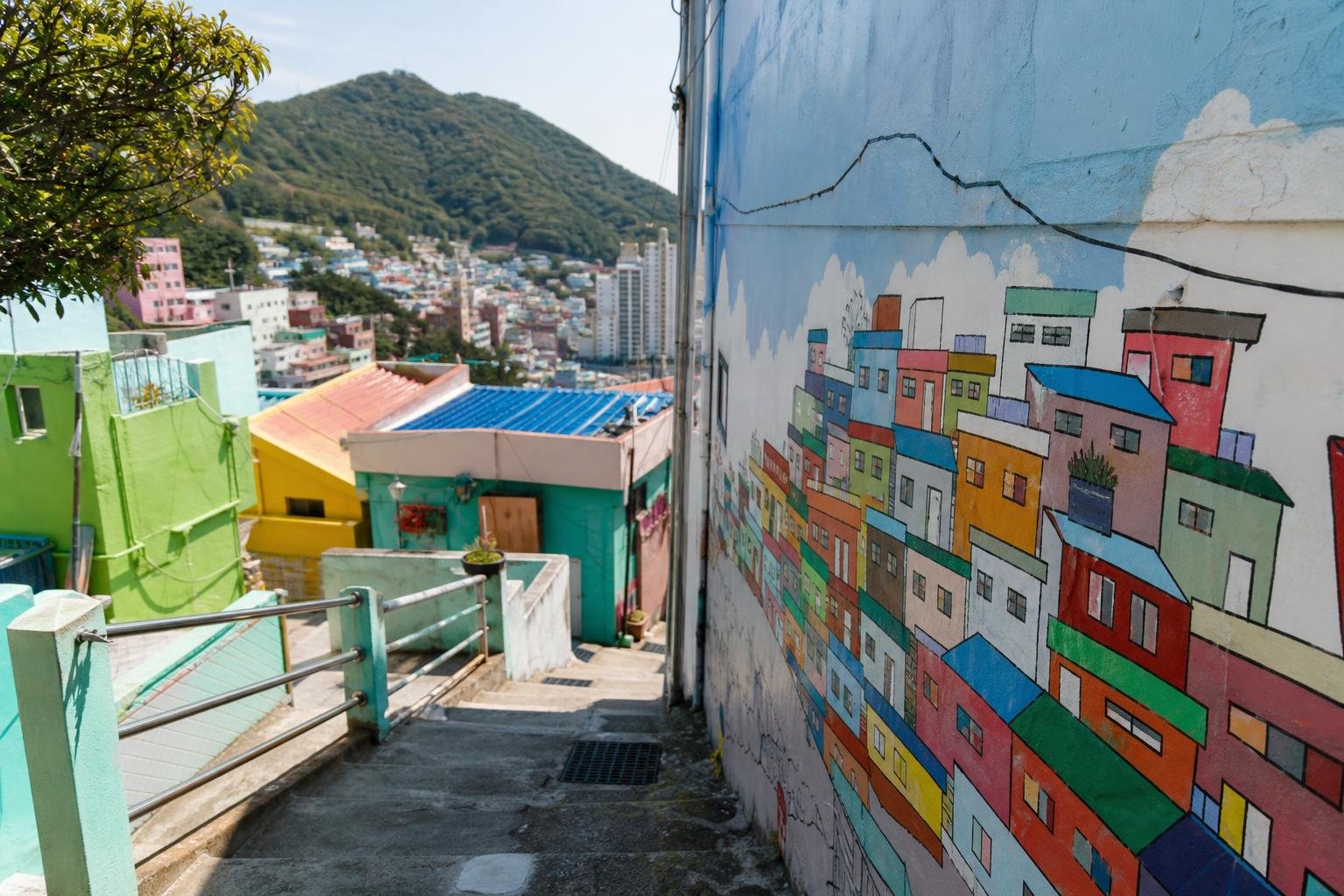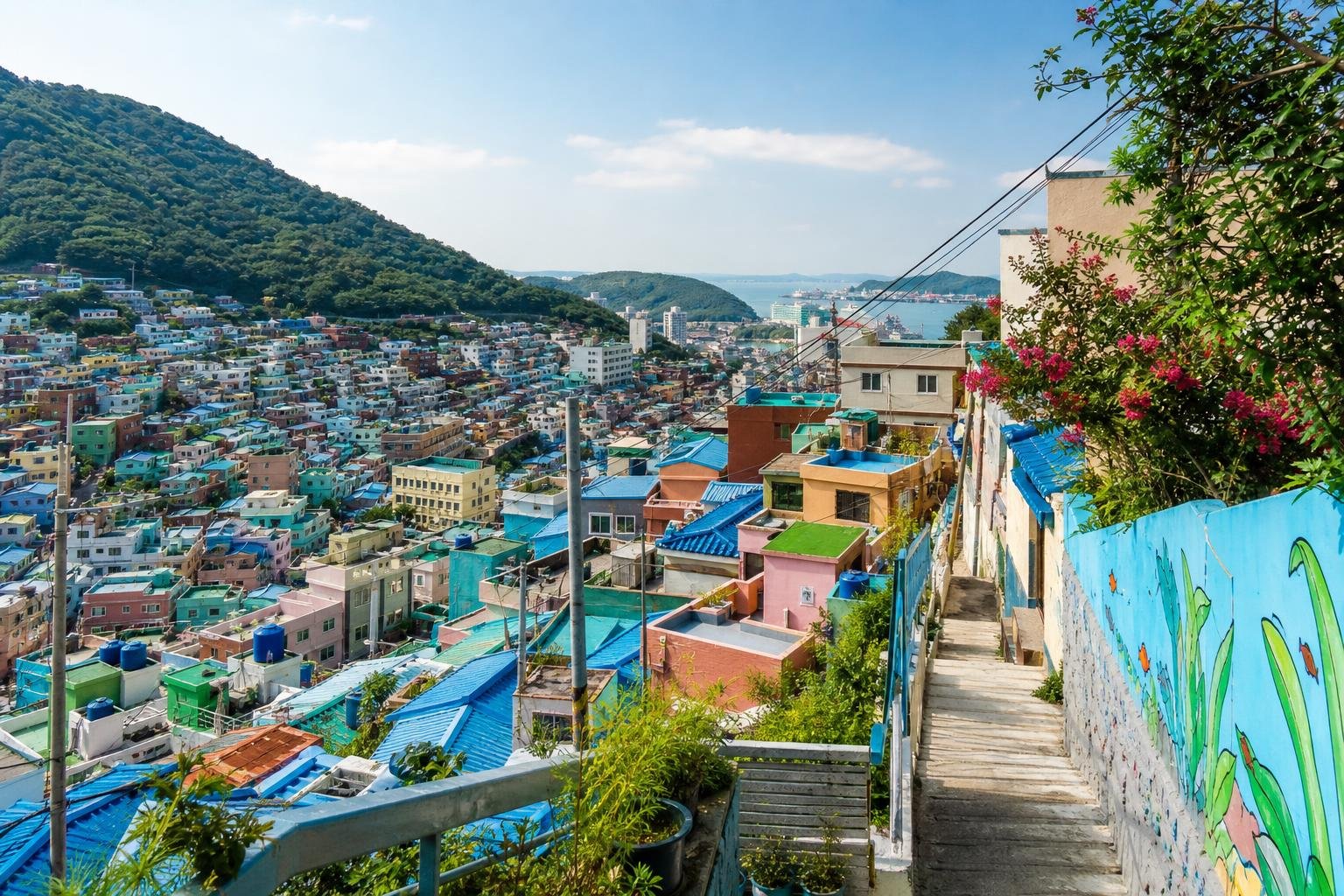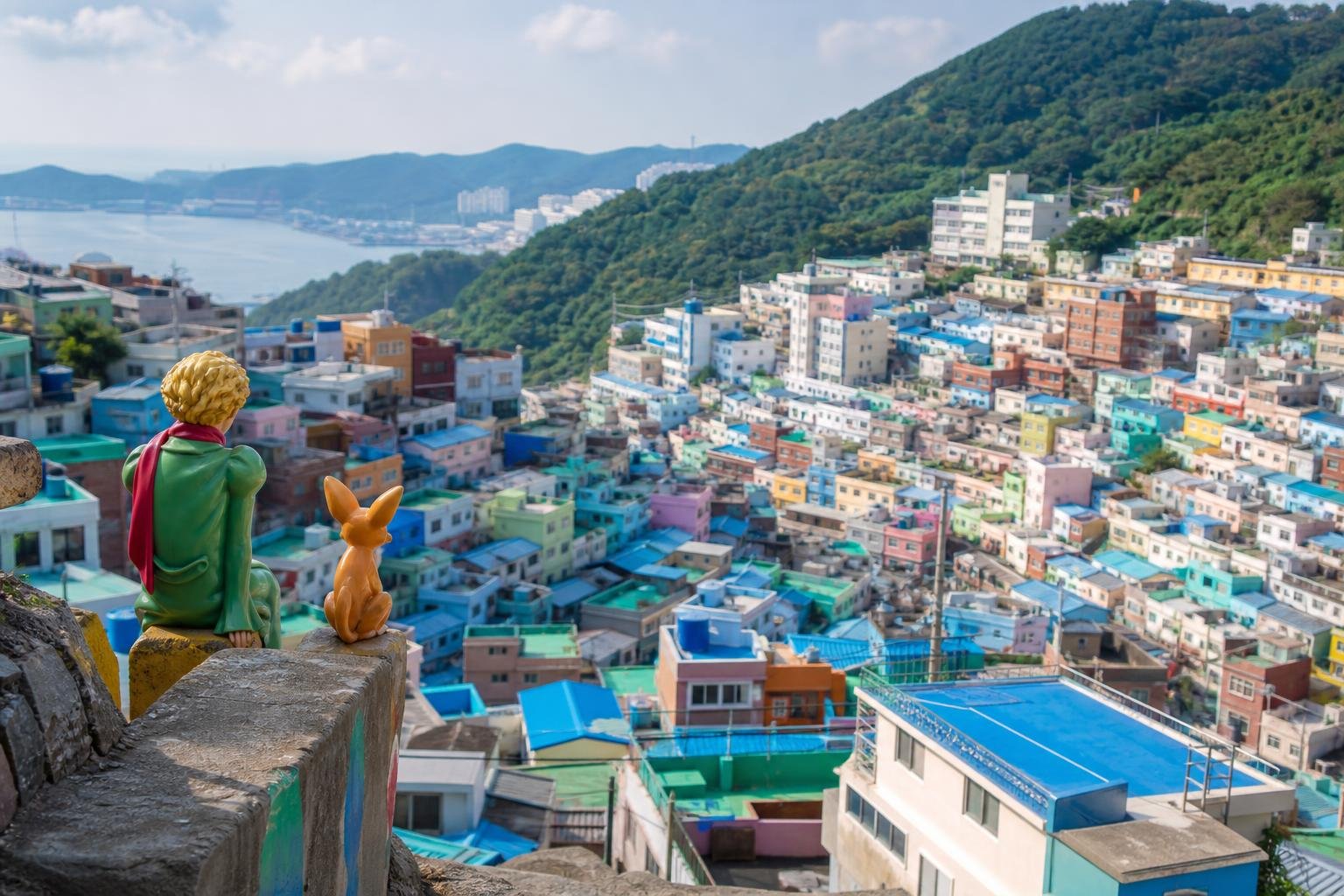
Gamcheon Culture Village is a colorful hillside area in Busan whose pastel homes, murals, cafés and tight alleyways have become instantly legible in travel feeds. The social-media version is easy to understand: it offers layered city views, painted surfaces and a sense that a short detour can yield many distinct frames. Yet the more useful way to read its online fame is not as proof of a newly viral attraction, nor as an endless open-air set. The posts surfaced in this research repeatedly present a neighborhood shaped by community art and local history, then compress that context into a fast-moving photo-stop narrative.
Table of contents

That tension is the point. A visitor can enjoy the visual pleasure without pretending it is accidental, untouched or equivalent to a famous site elsewhere. The village’s continuing appeal lies in the way its physical form translates unusually well to Instagram Reels and TikTok: colour establishes the location before a caption does, slopes create depth, and a turn into an alley promises another image. What gets missed is that the language of “every corner” and “hidden gems” changes a lived district into a sequence of collectible shots.
Why Gamcheon Culture Village works so well on camera
The strongest recurring description comes from an Instagram reel by World Cities Unlocked, whose search snippet calls it “a vibrant hillside village” with pastel houses, murals, cute cafés and narrow alleys, adding that every corner is a photo spot. That is a compact explanation of its visual grammar. A hillside makes houses appear in layers rather than as a flat streetscape. Painted exteriors and murals give creators foreground detail. Narrow passages turn walking itself into a reveal: an image can shift from a close wall texture to a broad view within a few steps.
The phrase “every corner is a photo spot” is persuasive social copy, not a literal inventory. It tells viewers that they do not need a specialist itinerary or a single landmark to make content. Instead, the destination is sold as abundant: a café frontage, an overlook, a stairway, a mural, a cluster of roofs. This is particularly suited to short video, where the rhythm often depends on quick changes of scene. It also suits carousel posts, where variety can be built from one walk rather than several separate destinations.
That visual abundance helps explain why the village appears naturally in Busan round-ups. A beach or a tower may need an establishing shot and a location label; colorful, densely stacked homes are more immediately recognizable as imagery. The village can play several roles at once in an itinerary video: a daytime stop, a café stop, a place to wander and a background for portrait photography. This does not mean all corners are equally appropriate to photograph or that every visitor experiences the same access. It means the visual features named in creator captions are unusually easy to turn into a repeatable travel format.
There is also a commercial logic beneath the apparently spontaneous discovery. “Must-see,” “guide,” “save this,” “free” and “hidden gem” are useful content signals because they ask viewers to store a post for a future trip. The TikTok post “Busan’s FREE Hidden Gems: Part 2 | Must-See Spots!” explicitly frames its village entry as a guide to save for a Busan trip. That wording moves the place from an observed neighborhood to an itinerary unit. Cafés, meanwhile, are not merely background details; their inclusion in the Instagram description makes the stop appear compatible with a familiar travel-content routine of walking, photographing and pausing to buy something.
From local place to international travel shorthand

On TikTok, creators often translate a location through comparisons that audiences can understand in a second. One result, a travel video by Meraki, says Busan’s colorful district looks like “someone painted a Greek village in Korean colors.” The TikTok post is useful less as a description of architectural history than as an example of platform language. “Greek village” cues white-and-blue, cliffside holiday imagery for an international audience, while “Korean colors” supplies novelty and national identity. It is memorable because it is hybrid, but it also risks suggesting that the place needs a European reference point to be visually understood.
A similar shortcut appears in the result titled “Busan’s FREE Hidden Gems: Part 2 | Must-See Spots!”, whose visible snippet begins to describe the village with a “Machu…” nickname. Search material supplied for this article identifies the recurring comparison as a Machu Picchu-style one. Treat that as creator shorthand, not an official alternative name and not a serious cultural equivalence. It tells viewers to expect a steep, densely layered settlement and panoramic composition. It cannot explain the neighborhood’s own history, social relationships or art projects.
These comparisons are a form of translation, though not the language-learning kind. They convert a specific Busan setting into familiar global travel categories: the colorful hill town, the secret alley, the Mediterranean-looking scene, the dramatic overlook. That translation lowers the barrier to attention and makes captions work across languages. At the same time, it can erase precisely what makes a place particular. The comparison travels; the local context may remain in the voice-over, if it appears at all, or disappear beneath location tags and upbeat editing.
There is nothing inherently wrong with a creator saying that a view reminds them of another place. The problem arrives when metaphor hardens into fact. “Korea’s Machu Picchu” can imply a sanctioned nickname, a comparable historical status or a direct cultural relationship that the snippet does not establish. “Greek village in Korean colors” can make a Korean neighborhood sound like an imitation rather than a place with its own visual and social development. A more accurate caption can keep the useful practical description – colorful homes climbing a Busan hillside – while naming the comparison as a personal impression rather than the destination’s identity.
Gamcheon Culture Village and the context behind the mural
The clearest contextual clue in the supplied results appears in a TikTok video by kyoungwon1017. Its search snippet describes “colorful streets and community art that narrate neighborhood history.” That brief phrase matters. It shifts the village away from the idea of decoration installed solely for visitor photographs. “Community art” points toward art in relation to a neighborhood, while “narrate” suggests that streets and artworks can communicate stories rather than function only as visual surfaces.
Visitors do not need to become historians before taking a picture. But the distinction changes how they move through the area. A mural may be a compelling backdrop and also part of a local account. An alley can be picturesque and still be part of residents’ everyday circulation. A café can be a welcome place to rest, but its presence in a reel also participates in a tourism economy that turns visual attention into spending. Holding these truths together produces better travel content than presenting the village as a blank canvas waiting for a pose.
It also changes the common “hidden gem” label. A place continuously featured in Instagram reels, TikTok guides and Busan lists is not hidden in the ordinary sense. On social media, “hidden” usually means that the creator is offering the audience a feeling of discovery, even when the destination is already well known. The label is commercially effective because it gives a viewer the role of early finder. For a neighborhood, however, that language can obscure the fact that people already live, work and remember there. Discovery is being experienced by the visitor, not created by the post.
The available material has a defined limit: it consists of social-platform search snippets, with no displayed posting dates, Korean-language captions, official tourism or local-government material, resident interviews, academic research, visitor figures or documentation of specific art projects. It therefore cannot establish the village’s precise origins, identify the earliest post that drove attention, verify a current growth curve, or settle what local participants think of tourism. The social results can show recurring creator framing; they cannot, on their own, substitute for a complete local history.
Participation without treating a neighborhood as a set
A respectful visit begins with a simple reframing: photos are part of the experience, not the entire purpose of the place. Keep voices low in narrow passages, do not block doorways or stairways while composing an image, and avoid treating homes as props. If a shot requires entering a private-looking space, moving furniture, lingering at an entrance or directing others through a passage, it is not a casual photo opportunity. The same consideration applies to filming strangers, especially people going about routine work or errands.
Creators can improve the translation for their own audiences with small, concrete choices. Name Busan rather than using only a comparison. Describe a mural as community art when that is the context provided, rather than calling all painted walls “Instagram walls.” Separate a personal visual association from a factual label. Show the walk between scenic moments, not just a rapid montage of surfaces. These choices make content less extractive without making it less attractive.
For trip planning, the village remains a strong choice if the appeal is a walk through color, art, hills and small-scale visual detail. It is a weaker choice if the expectation is a theme park designed to deliver uninterrupted photo backdrops. The same posts that make it tempting also reveal that its charm depends on proximity: close alleys, buildings, cafés and artwork. That proximity demands a little patience from visitors and a little precision from people publishing about it.
Its likely staying power should be described cautiously. Repeated Instagram and TikTok framing indicates an established visual-tourism appeal rather than a one-off meme, and the guide-style language suggests it is easy to keep circulating among future Busan planners. But visibility is not the same as a verified surge, broad adoption or long-term tourism performance. The more durable story is simpler: a colorful Busan neighborhood has become highly shareable because its physical setting rewards the camera, while the community-art and neighborhood-history context asks viewers to look beyond the frame.
Sources and verification

- Busan's 3 Jaw-Dropping Secrets Discover the fascinating facts … – Instagram · worldcitiesunlocked / Other search result
- Liberation Day and Traitors #korea #koreanhistory … – TikTok · kyoungwon1017 / Other search result
- Dancing our way to Seoul! ❤️🔥 Support us by liking … – TikTok · meraki / Other search result
- Busan's FREE Hidden Gems: Part 2 | Must-See Spots! – TikTok · Andrea |Travel Content Creator / Other search result
Frequently Asked Questions
Is Gamcheon Culture Village really a “hidden gem”?
Not in the literal sense suggested by social-media captions. The supplied Instagram and TikTok results repeatedly feature it in Busan travel content. “Hidden gem” works mainly as creator language that gives viewers a feeling of discovery, rather than as proof that the neighborhood is unknown or newly found.
Why do creators compare the village with Greece or Machu Picchu?
Those comparisons are quick visual shorthand for colorful hillside buildings, layered views and narrow walking routes. They can help an international viewer picture the setting, but they are personal creator metaphors, not official names, historical classifications or evidence of a cultural connection to either place.
How can visitors photograph Gamcheon Culture Village respectfully?
Treat it as a neighborhood rather than a purpose-built set. Keep doorways and stairways clear, stay quiet in close residential passages, avoid filming people without consideration, and do not enter private-looking spaces for a shot. Captions can also mention Busan, community art and neighborhood history instead of relying only on global comparisons.
Explore more K-culture stories
Editorial disclosure: Automated tools assisted with research and drafting. An editor reviewed the sources, factual claims, dates, and wording before publication. Time-sensitive details can change, so confirm them with the linked official sources.
RECOMMENDED SITE
Planning a trip to Korea?
Discover practical Korea travel guides, local tips and destination ideas at KoreaSpot.