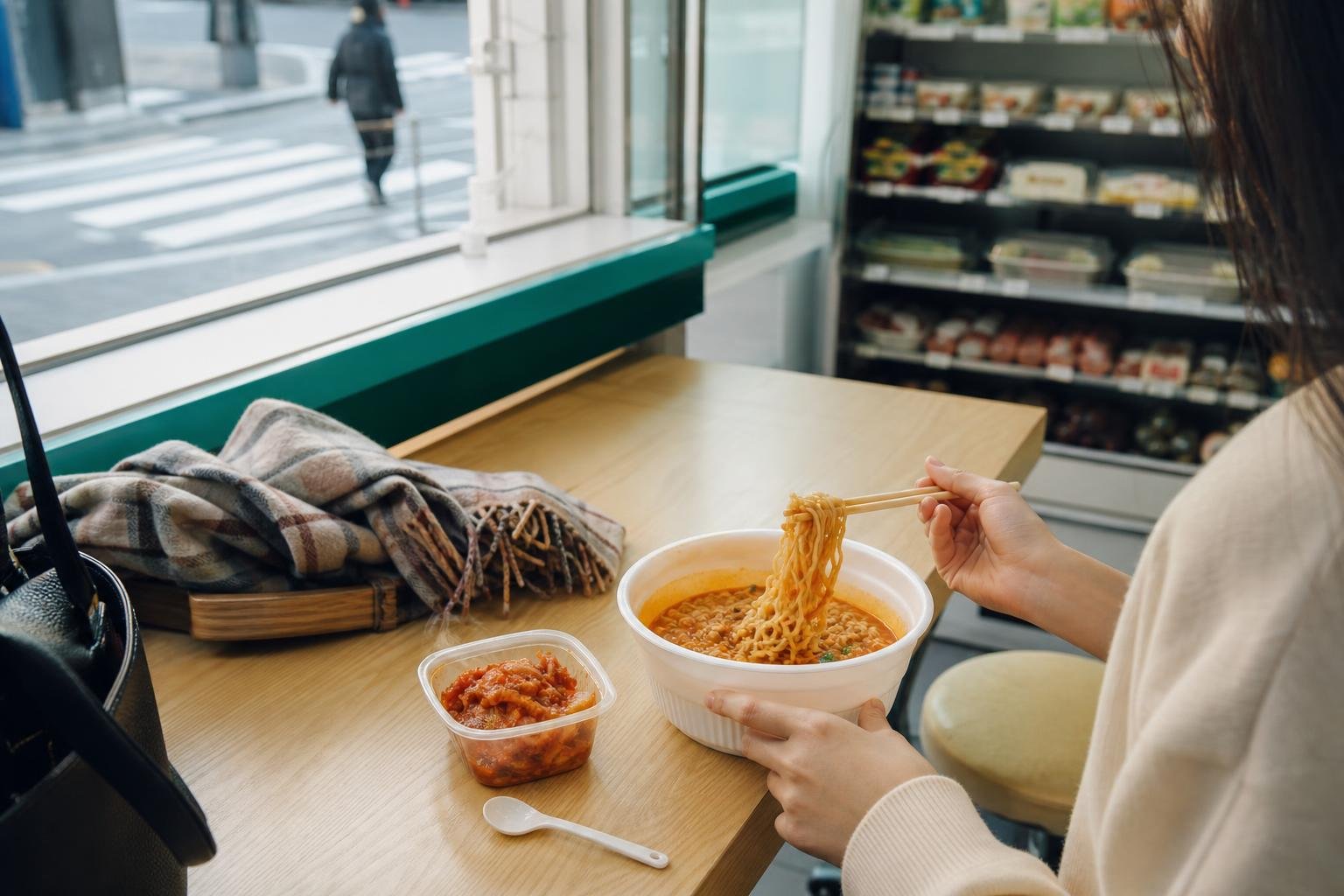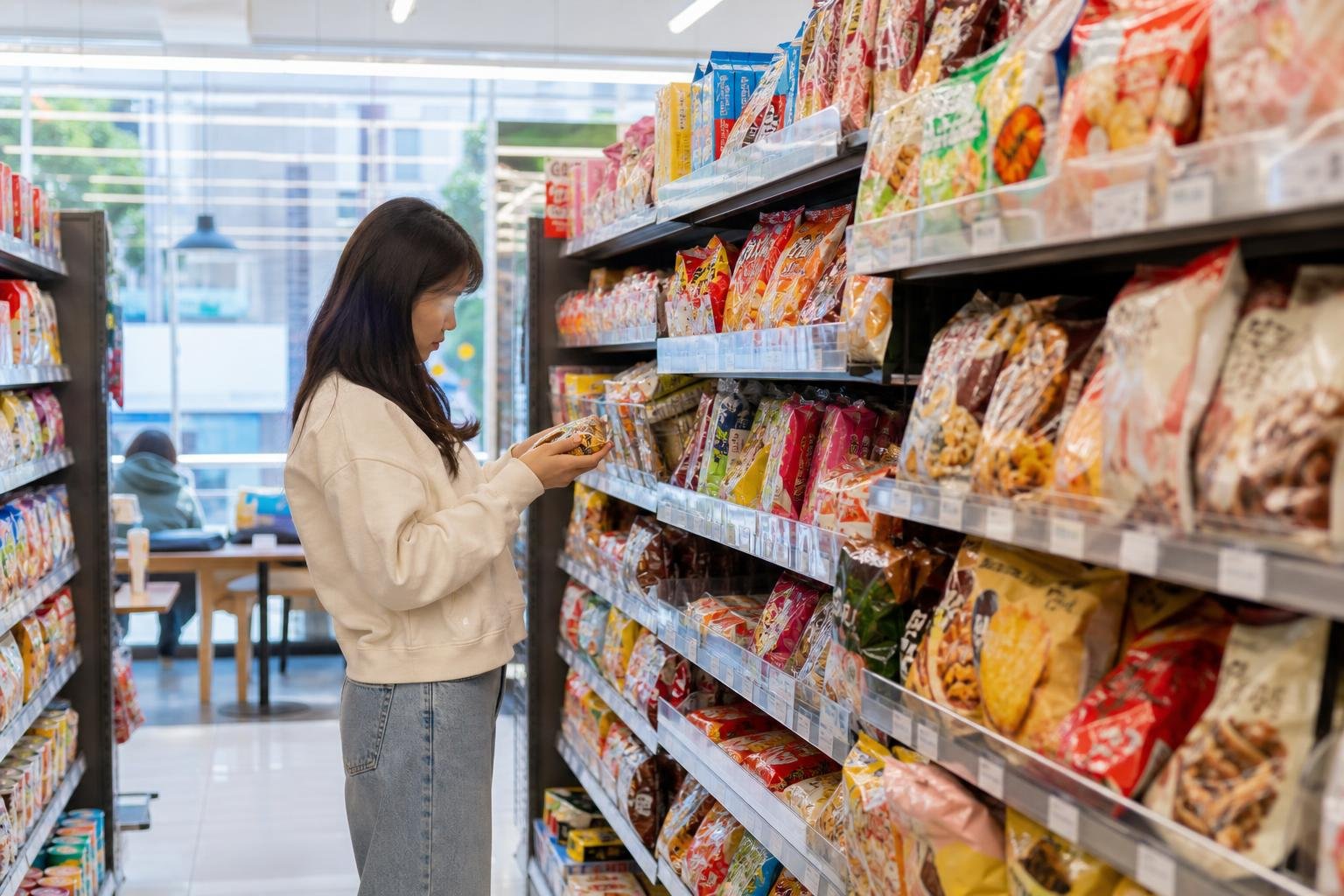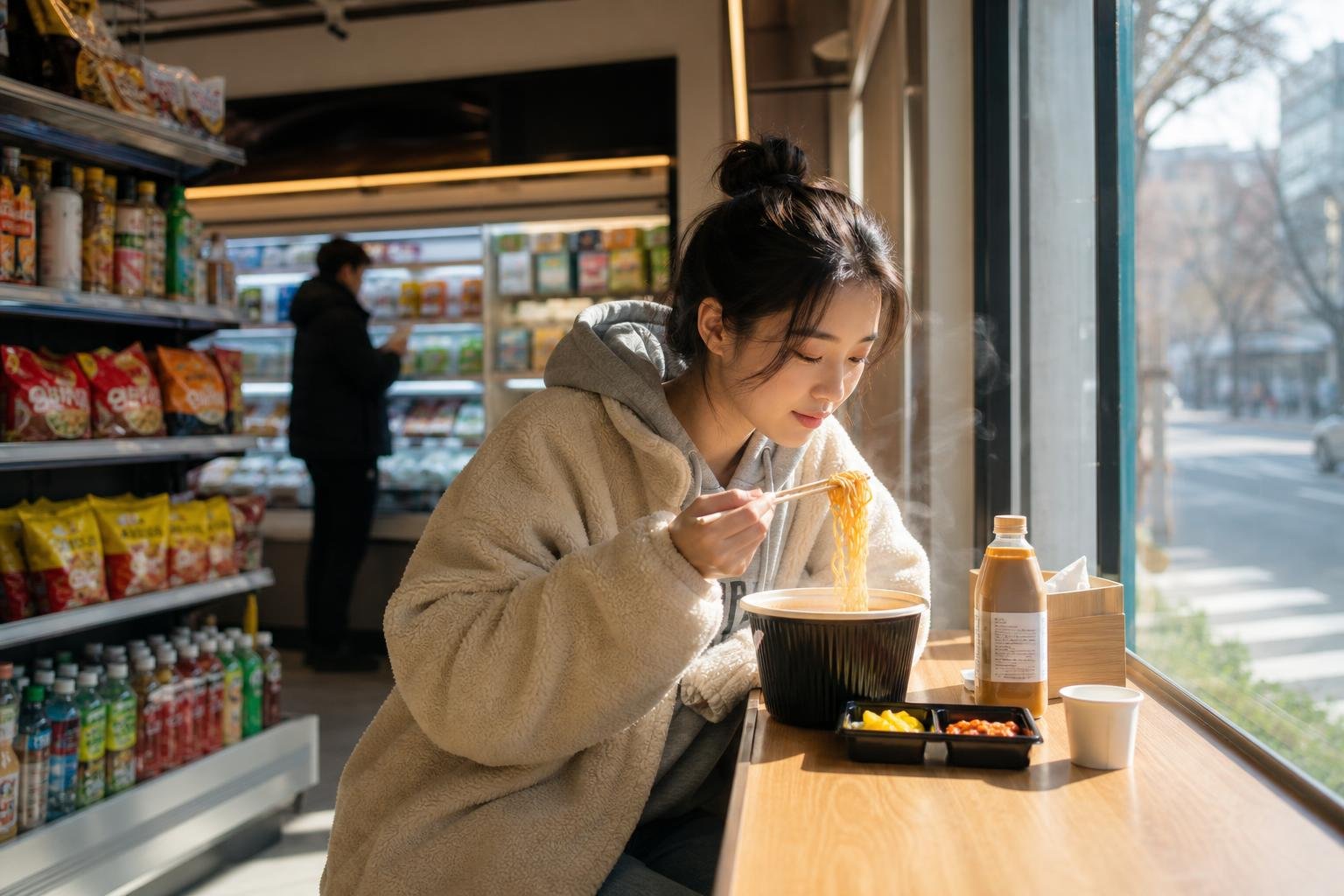
Korean convenience store combinations are best understood as a flexible food format, not a single official menu. The clips that travel most easily tend to begin with a small basket: instant ramen, a packaged snack or sweet, and a bottled drink. A TikTok search result from creator neikks explicitly associates Korean convenience stores with those categories, offering a useful, if narrow, snapshot of the visual vocabulary now circulating online. What makes the format sticky is that it asks viewers to do more than watch: choose, assemble, taste, judge, and make a version of their own.
Table of contents

That distinction matters. Online captions often flatten a shopping trip into “the Korean combo,” as though every item carries a fixed cultural rule. The more accurate reading is simpler and more interesting: convenience-store food gives people an accessible set of packaged choices, and short-form video turns selection into the story. A noodle cup can be the warm center of a meal; a sweet or salty packaged item can supply contrast; a cold bottled beverage can finish the frame. The combination is personal, portable, and instantly legible on a phone screen.
For a visitor, student, or K-culture follower, the useful question is not “Which one combination is authentic?” It is “How can I build a satisfying pairing without mistaking a creator’s preference for a national rule?” Start with the categories that are actually visible in the available social record, then treat the final choice as your own taste test. Store selection, product packaging, and preparation options can vary by location and market, so leave room for substitution.
What “Korean convenience store combinations” usually means
The phrase has become a loose label for an assembled mini-meal or tasting spread bought in one stop. It may mean foods eaten side by side, items opened in sequence, or products selected because their textures and flavors play well together on camera. It does not identify a standardized Korean dish, a regulated menu category, or one verified recipe with an agreed origin.
The clearest directly attributable example in the available record is the category list attached to neikks’s TikTok result: instant ramen varieties, packaged Korean snacks and sweets, and bottled beverages. That is enough to describe the recurring structure without pretending to know which brands, flavors, or mash-ups are most widely purchased. The post itself is a social-media example, not a survey of Korean eating habits or a retailer’s sales record.
A useful way to assemble one
Think in roles, not rules. Pick one warm or savory anchor, one contrasting packaged item, and one drink. The method travels well because it works with what is actually on the shelf. If a particular noodle variety is unavailable, another instant ramen can fill the same role. If a much-hyped sweet has sold out, choose a different packaged dessert or snack that sounds appealing.
- Anchor: instant ramen or another ready-to-eat savory item available at the store.
- Contrast: a packaged snack or sweet chosen for crunch, richness, spice, or a change of pace.
- Drink: a bottled beverage selected to cool, complement, or simply accompany the meal.
- Test: try each item separately before deciding whether a bite-and-sip pairing is actually better together.
This is a more honest recreation than chasing an alleged must-order list. It preserves the activity people are responding to—the small act of curating a meal from a limited shelf—while avoiding claims that any one pairing represents how everyone in Korea eats.
Why Korean convenience store content fits short-form video

The format has a built-in beginning, middle, and payoff. A creator starts at the shelf, narrows several choices to a few purchases, opens or prepares them, then gives a reaction. Even when the food is ordinary packaged fare, the progression creates a compact narrative with an obvious invitation: “What would you pick?” That invitation is especially useful on platforms where audience response is part of the entertainment.
Vogue Business describes its TikTok Trend Tracker as weekly data on creators and trends moving through TikTok’s Gen Z user base. That broader framing helps explain why convenience-store food is so adaptable to the platform’s trend machinery: it is easy to repeat, easy to personalize, and easy to change with a different flavor, budget, mood, or location. The category-level setup can remain familiar while every video presents a fresh choice.
There is also an important difference between visibility and scale. A widely shared clip can establish a recognizable visual script—basket, noodle cup, snack, drink, verdict—without demonstrating that the exact purchase is routine across Korea. A creator may be documenting a familiar stop, staging a taste test for an audience, or both. The camera captures a real selection in a real moment; it does not automatically measure national popularity.
International viewers often add another layer. In an English-language caption, “convenience-store combo” can sound like a named specialty. In practice, the term may be doing promotional work: it turns an ordinary act of choosing packaged food into a challenge, a recommendation, or a travel ritual. That translation is not necessarily deceptive, but it can make improvisation look more fixed than it is.
What is documented, and what remains a viral claim
The responsible dividing line is straightforward. The available TikTok record supports the presence of ramen, snacks and sweets, and bottled beverages in content associated with Korean convenience stores. It supports treating creator-led food selection as part of the online conversation. It does not establish the first person to make a combination video, the first Korean store to encourage the format, a definitive Korean name for the practice, or a nationwide ranking of favorite pairings.
That missing origin trail is worth stating once because origin stories are unusually prone to drift online. A repost may be newer than the video it repackages. A translated caption may replace a specific personal recommendation with a sweeping “Koreans always do this” claim. A clip filmed for tourists may circulate alongside clips aimed at local followers. None of those possibilities makes the content worthless; they simply change what the content can prove.
When you encounter a particularly precise claim—“this is the most popular ramen mix,” “everyone buys these together,” or “this hack started at a certain chain”—look for a dated original post, a Korean-language source with context, a retailer announcement, or reporting that identifies participants and methods. Without that trail, describe it as a creator’s combination, not a settled fact.
Questions that improve a viral-food recommendation
- Is the video showing an individual’s choice, or does it cite a store, manufacturer, or survey?
- Does the caption identify where and when it was filmed?
- Are viewers being encouraged to copy a flavor pairing, or simply to enjoy the browsing format?
- Would the recommendation still work if one item were replaced by a locally available equivalent?
Those questions protect the fun of the trend. They also prevent a familiar Korean setting from being reduced to a prop for an invented universal habit.
How to try the format without turning it into a checklist
Build for your own appetite first. If you want a meal, make ramen or another savory ready-to-eat item the center and keep the snack modest. If you are filming a taste test with friends, split several small packaged items rather than buying a large amount of food for a single shot. The appeal lies in comparison: crisp against soft, savory beside sweet, hot food followed by a cold drink. It does not require forcing every item into one bowl or treating novelty as a measure of authenticity.
Outside Korea, use the format rather than claiming to reproduce an exact scene. An Asian grocery, a campus market, or a neighborhood shop may stock different noodle cups, snacks, sweets, and beverages. That variation is not a failure. The point is to make a small, coherent set of choices and be clear about where those products came from. If you post it, name the items you used, distinguish your remix from a documented recommendation, and avoid captions that speak for an entire country.
A considerate video can be more compelling than a hyperbolic one. Show the packaging clearly enough for viewers to identify it, say what you liked and what you would change, and leave space for people with different spice tolerance, dietary needs, or budgets. “My ramen-and-snack pick” is more useful than declaring a universal winner.
Will the format outlast any one food hack?

Individual pairings may have a short online life because novelty is part of their appeal. The larger format has better odds of remaining recognizable: it can absorb seasonal products, new snack releases, different cities, and each creator’s budget without needing a single canonical recipe. Its durability comes from participation, not from a fixed menu.
The next meaningful sign of staying power would not be another recycled montage with a broader caption. It would be a clearer record: dated Korean-language posts that show sustained local participation over time, or retailer and producer material that directly connects a product launch or campaign to consumer-made pairings. Until then, Korean convenience store content is most compelling as a small-scale social ritual—browse, choose, taste, and compare—whose best version leaves room for the person holding the basket.
Official Sources and Verification
- i got promoted twice at my teaching job in korea!🇰 … — Supporting source: associated with Korean convenience stores include instant ramen varieties, packaged Korean snacks and sweets, bottled beverages popular the student ☺️. Source: TikTok · neikks
- The Vogue Business TikTok Trend Tracker — Established reporting: Vogue Business brings you weekly exclusive data from TikTok, unpacking the latest creators and biggest trends sweeping its Gen Z user base. Source: Vogue (7 days ago)
Frequently Asked Questions
What are Korean convenience store combinations?
They are informal pairings or assembled mini-meals selected from convenience-store shelves, often built around instant ramen, a packaged snack or sweet, and a bottled beverage. They are not a single official menu or standardized Korean recipe.
What foods are most often shown in these videos?
The available TikTok example associates Korean convenience-store content with instant ramen varieties, packaged Korean snacks and sweets, and bottled beverages. It does not establish a definitive list of the country’s most popular pairings.
Can I recreate the trend outside Korea?
Yes. Use the format—one savory anchor, one contrasting packaged snack or sweet, and a drink—while describing your choices as a personal remix. Product availability and preparation options vary by store and country.
Explore more K-culture stories
RECOMMENDED SITE
Planning a trip to Korea?
Discover practical Korea travel guides, local tips and destination ideas at KoreaSpot.